

Top 9 Most Common Types of Fasteners and Their Uses
July 07, 2026
Picking the right fastener can feel like choosing the right puzzle piece in a giant box. Get it wrong, and your project wobbles, leaks, or falls apart. But when you get it right, it all comes together easily.
From furniture assembly to automotive repairs, the right fastener keeps everything together, and knowing the common fastener types used in different industries can save you a lot of headaches.
Introduction to Different Types of Fasteners
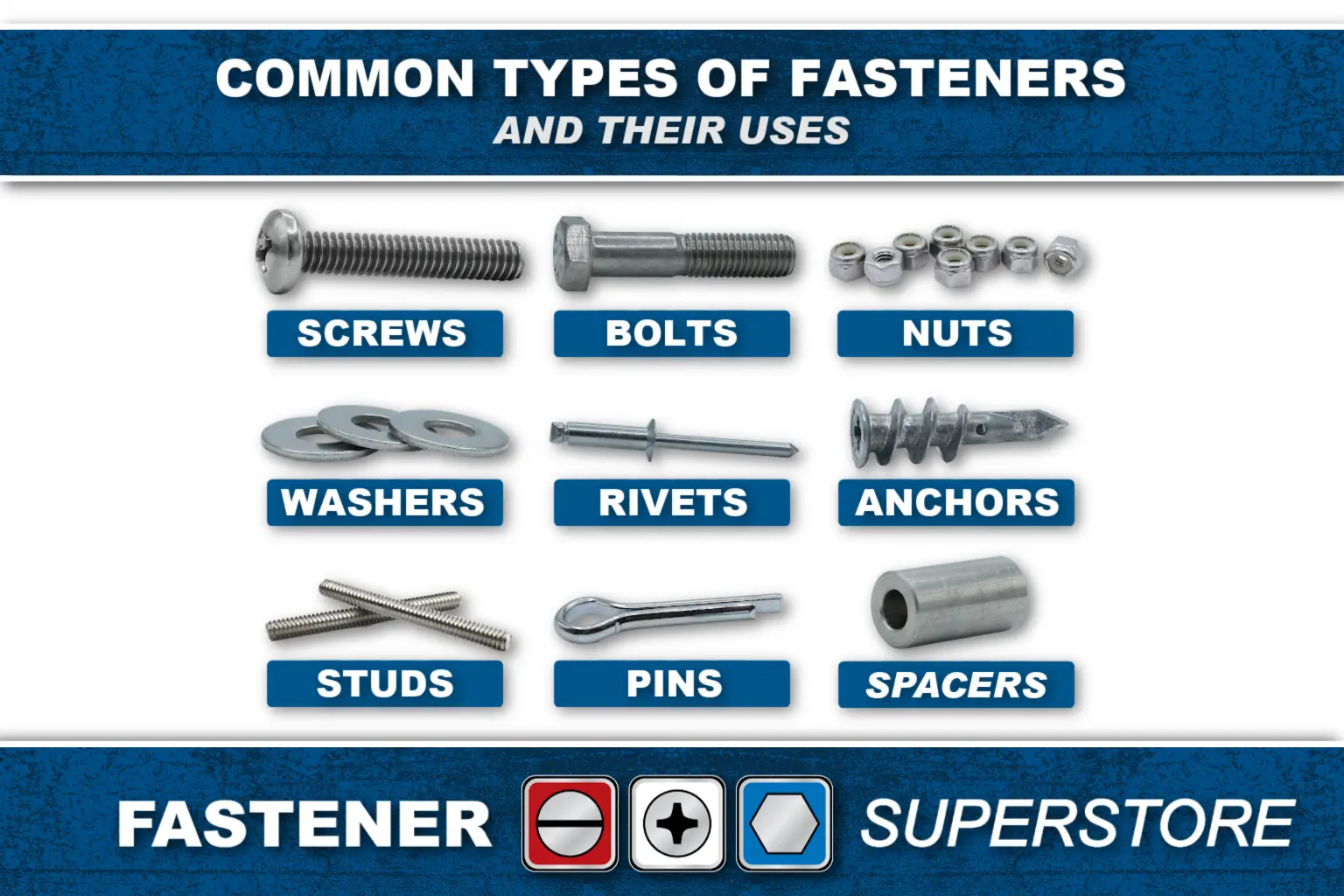
Fasteners join two surfaces or parts, either permanently or temporarily, and show up in everything from furniture assembly to electronics and construction. Fasteners are categorized into threaded types (screws, bolts, nuts) and unthreaded types (rivets, pins, washers). Picking the right one ensures secure fastening, avoids damage, and saves frustration.
We’ll cover 9 of the most commonly used fastener types and give you tips on choosing the best one for your next project.
1. Wood, Cap, Self-Drilling, and Machine Screws
Screws are among the most versatile fasteners, providing durable holding power without requiring additional components to secure them.
The most common types you've probably heard of include wood screws (coarse threads for wood) and sheet metal screws (sharp threads for cutting into metal). But it doesn't stop there. Knowing which one to grab can make your project way easier.
Machine screws have a solid shaft with threads running along its length. They're commonly used in consumer electronics or in precision machinery applications. Machine screws usually require internal threads or a nut to hold them in place. Pick the right length and material, especially if you’re fastening soft metals or hard plastics.
Socket head cap screws have a recessed hex shape, so you can use a hex key in tight spots. They’re high-strength and perfect for automotive, machinery, and even aerospace jobs.
Self-drilling screws are DIY heroes. They drill their own hole and cut their own threads, eliminating the need for pre-drilling. Perfect for metal sheets, roofing, or siding, they make installation fast and easy, even with hard-to-handle sheet metal or soft materials.
2. Bolts: Carriage and Hex Head Styles
Carriage bolts have a smooth, rounded head and a square neck that locks into wood to keep the bolt from spinning when you tighten it. They’re great for decks, fences, or furniture assembly.
Hex head bolts can be tightened with wrenches or sockets. They’re used for structural projects, wood and metal assembly, and automotive applications. Pairing hex bolts with finished hex nuts ensures the clamp load is even and prevents it from vibrating loose.
3. Finished Hex Nuts and Lock Nuts
Finished hex nuts are the classic six-sided nuts you probably see everywhere. They help clamp things together and, with a flat washer, distribute the load evenly. Heavy hex nuts are thicker and wider, designed specifically for heavy-duty applications, such as steel frameworks or bridges, where tensile strength is critical. You'll even find them on most commercial construction projects.
Nylon lock nuts, or Nyloc nuts, feature a built-in locking mechanism that prevents loosening under vibration, making them perfect for automotive applications. They combine the classic hex shape with a nylon insert that holds the threads securely, keeping the connection secure.
Choosing the right nut type ensures you don’t have to worry about fasteners failing mid-project.
4. Multi-Grip, Structural, and Blind Rivets
Rivets are permanent fasteners widely used in industries that require strong, tamper-proof connections, such as aerospace and automotive manufacturing.
Blind rivets, or pop rivets, are fasteners used when access is limited to one side. They work well with thin sheet metal or panels. Multi-grip rivets handle most common materials of varying thicknesses, reducing the number of sizes you need and sealing moisture better than standard rivets.
Structural rivets are designed for high-strength applications, such as trailer bodies or heavy machinery. Accordingly, these solid rivets can withstand shear and tensile forces.
Rivets form a permanent joint that no ordinary screw or bolt can replicate. They are critical when a strong, tamper-proof connection is required.
5. Anchors
Anchors help fasteners hold in drywall panels, concrete, or masonry. Wedge anchors expand inside solid concrete or masonry to provide high-strength holding power.
For drywall and hollow walls, plastic expansion or ribbed anchors support light loads, such as shelves or pictures. Toggle bolt anchors handle heavier loads, while wallboard anchors in nylon or zinc alloy add a solid grip.
In concrete or masonry, wedge anchors expand within solid materials for high-strength holding. Sleeve anchors, drop-in anchors, and lag screw shield anchors are used for medium- to heavy-duty projects. Hammer-drive and split-drive anchors are great for quick installation and keeping the load secure.
Picking the right anchor prevents loosening — especially important with thermal expansion or heavy use.
6. Threaded Rods and Studs
Threaded rods and studs are long rods with continuous threads along the shaft. They’re excellent for joining two components, structural support, and furniture assembly. Proper installation considers clamp load, length, and material, and pairing with nuts and washers ensures secure fastening. These rods are versatile types used in construction, automotive applications, and DIY projects.
7. Clips and Cable Clamps
Cable clamps sort several wires and keep them from tangling. Nylon clamps come in standard and heavy-duty types, for residential or industrial wiring. U-clips, or speed clips, quickly hold metal, plastic, or wood panels. These are usually for automotive use, cabinetry, and light construction; they save time and are considered easy to install.
8. Flat Washers and Lock Washers
Washers are the unsung heroes that keep bolts and screws from embedding into your materials or from loosening over time. If you just need to spread the load, flat washers are the “go-to” option. You throw one under a bolt, and suddenly your wood or thin sheet metal doesn’t get gouged. The washers that combat vibration are the lock washers. If you’ve ever had a nut come loose on a moving part, a lock washer can save you that headache. They grip the nut and keep everything snug.
9. Pins
Cotter pins (also called split pins) hold nuts in place and are often used in machinery and automotive applications.
Dowels are solid cylindrical rods designed to pin furniture or machinery together with extreme precision. Spring pins, or roll pins, are hollow, split, and compressed into tight channels. They hold it all snugly in place with no screw or nut to deal with.
How to Pick the Correct Fastener
Selecting a fastener isn’t always a matter of reaching for whatever fits. It’s more akin to choosing the right hammer; you want something that will do the job. First, see what you’re securing. Metal? Wood? Plastic? Or a mix of two materials? Choose the wrong fastener, and you risk splitting wood, stripping threads, or leaving a mess.
Then consider what weight or force it will need to support. Are you hanging up a lightweight shelf or bolting down a heavy machine? That makes a huge difference. The length and diameter of screws must also be appropriate for the materials being joined to ensure a secure connection.
Environmental factors, such as exposure to moisture and chemicals, should be considered when selecting fasteners to ensure durability and performance. Stainless steel, galvanized steel, or aluminum is suitable for outdoor/wet conditions. 316-grade stainless steel is recommended for marine applications exposed to saltwater. Zinc-plated steel is recommended for indoor/dry environments due to its cost-effectiveness. Lock nuts are effective in applications experiencing vibration and impact.
Then there’s thread type. Self-tapping screws save a lot of time with sheet metal, necessitating pre-drilled holes in harder materials.
Final Thoughts on Knowing How to Choose the Right Fastener
Knowing how to select the right fastener for your project saves frustration, improves project quality, and ensures safety. From screws and carriage bolts to finished hex nuts and bulk washers, choosing the right fastener makes all the difference. Take the time to match materials, loads, and environmental conditions with the proper fastener type.
For all your fastening needs, shop Fastener SuperStore to find high-quality options, expert advice, and everything you need to get the job done right.