

Screw Fastener Sizes Explained: A Complete Guide for Beginners
July 06, 2026
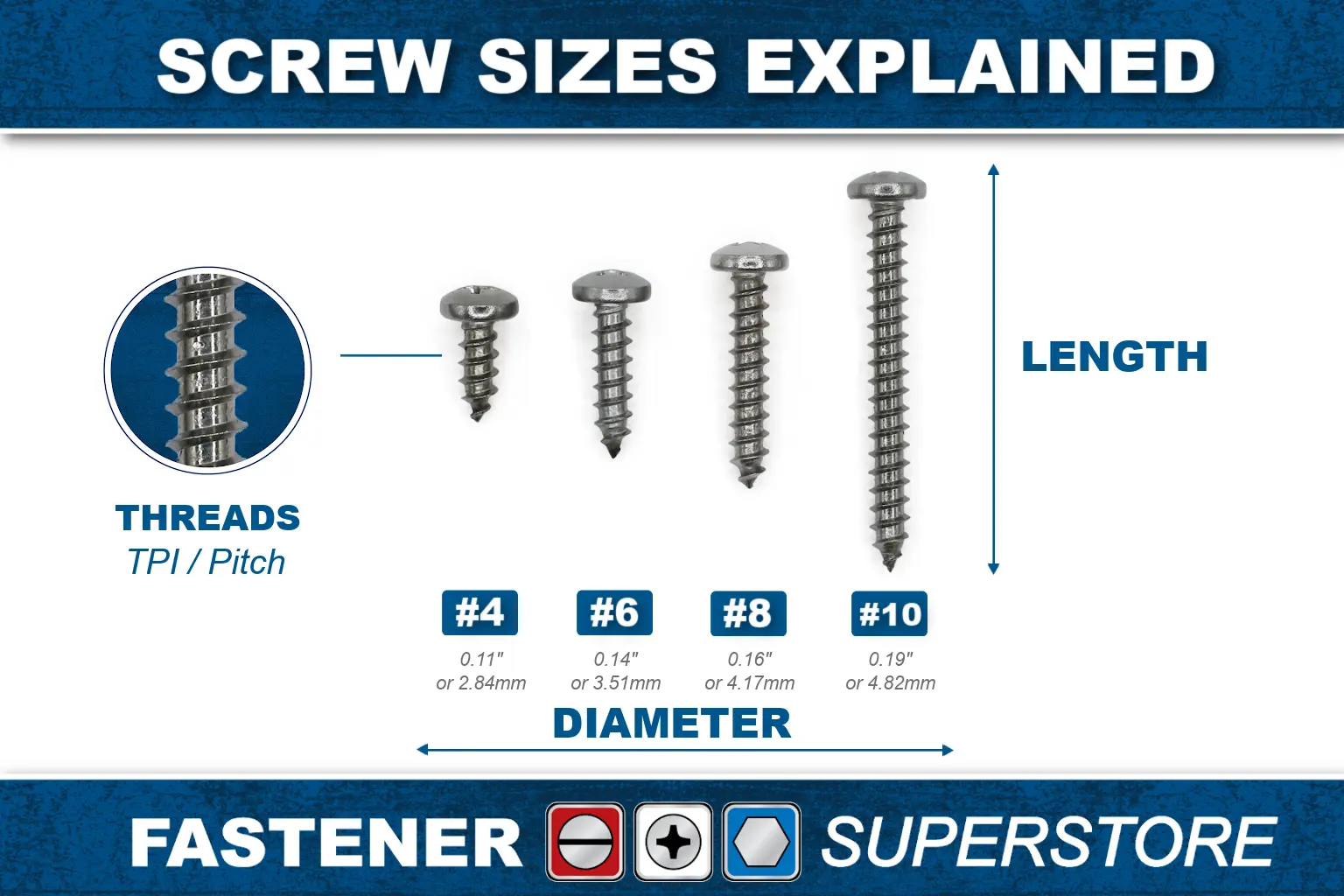
If you've ever stood in the hardware aisle staring at a wall of screws, wondering what #8-32 x 1" even means, you're not alone. Picking the right fasteners trips up beginners all the time, and it's usually because screw sizing involves a mix of gauge numbers, thread counts, and measurement systems that nobody ever explains in plain English. This guide fixes that.
Why Screw Size Matters
Using the wrong screw size causes real problems. A screw that's too thin won't hold, and one that's too short won't grip properly. Stripped screw threads, loose joints, and structural failure are all consequences of a bad size choice. A good rule of thumb is the 2/3 Rule: roughly two-thirds of the screw's length should penetrate into the bottom material for solid holding power. Get the correct diameter and length right from the start, and your build will thank you.
Notation Screw Sizes Explained
Reading screw size notation feels like a secret code at first. Once you break it down, though, it's actually pretty logical. There are two systems you'll run into: Imperial and Metric.
Imperial System Screw Size Notation
Imperial screw sizes use a format like #8-32 x 1". That breaks down into three parts. The first number (#8) is the gauge, which tells you the screw's diameter. The second number (32) is the threads per inch (TPI), meaning how many screw threads fit in one inch of the screw shaft. The last part (1") is the one-inch length. US fasteners follow the unified thread standard, a system established across the US and Canada to maintain consistent sizing across manufacturers. The tricky part is that gauge numbers don't directly translate to inches in an obvious way, which is exactly why screw size charts exist.
Metric System Screw Size Notation
Metric sizing is honestly a little easier to understand. A metric screw reads something like M6 x 1.0 x 25. The "M" means metric, the 6 is the diameter in millimeters, 1.0 is the thread pitch between thread peaks in mm, and 25 is the length in millimeters. Because metric sizing uses direct measurements, there's less guesswork involved. You'll most often run into metric screws in electronics, imported equipment, and anything manufactured outside North America.
What Do the Numbers Mean?
Understanding the numbers you see on screws will help you make smarter choices at the hardware store.
Gauge Numbers and Screw Diameter
In the Imperial system, screw diameter is expressed as a gauge number. A higher gauge number means a larger diameter, so a #10 screw is thicker than a #6. Common sizes you'll use around the house or on job sites run from #6 through #14. The major diameter of a screw refers to the widest point across the thread peaks, while the minor diameter is the narrower measurement at the base of the threads, also called the thread diameter.
Metric Thread vs Imperial (TPI)
Imperial screws use threads per inch (TPI), and more threads packed into an inch means a finer thread. Metric screws use thread pitch, which is the distance between threads measured in millimeters. According to Engineering ToolBox, coarse threads are best for soft materials like wood and plastic, while fine threads are better suited for metal and pre-tapped applications.
How to Measure a Screw
Measuring a screw correctly comes down to three things: diameter, length, and thread pitch.
Measuring Screw Diameter
The most reliable way to measure screw diameter is with a caliper. Slide it across the widest part of the screw threads to get the major diameter. A ruler works in a pinch, but calipers give you the precision you need to find the correct diameter, especially for smaller gauges where a fraction of a millimeter makes a real difference.
Measuring Screw Length
Length measurement depends on the screw head type. With flat-head screws and other countersunk styles, you'll measure from the very top of the screw head to the tip. For round head and pan head styles, measure from under the head size to the tip.
Measuring Thread Pitch
The easiest tool for measuring thread pitch is a thread pitch gauge. Press the gauge blades against the screw threads until one fits snugly; that blade tells you the pitch.
You can also count the threads across a known length with a ruler, though it takes a steady hand. Both methods work for identifying US screw sizes and metric sizing alike.
Complete Screw Size Charts and Conversion Guides
Rather than doing mental gymnastics between gauge numbers, fractions, and millimeters, the right chart gives you the answer in seconds.
US Imperial Screw Sizes
The Imperial chart below covers gauge numbers from #0 through #14, showing decimal diameter in inches, coarse TPI, fine TPI, and typical length ranges. Because the relationship between gauge numbers and actual dimensions isn't intuitive, this chart is one you'll want to bookmark.
| Gauge | Diameter (inches) | Coarse TPI | Fine TPI | Common Length Range |
|---|---|---|---|---|
| #0 | 0.060 | 80 | — | 1/8" – 3/8" |
| #1 | 0.073 | 64 | 72 | 1/8" – 1/2" |
| #2 | 0.086 | 56 | 64 | 1/4" – 3/4" |
| #3 | 0.099 | 48 | 56 | 1/4" – 3/4" |
| #4 | 0.112 | 40 | 48 | 1/4" – 1" |
| #5 | 0.125 | 40 | 44 | 3/8" – 1" |
| #6 | 0.138 | 32 | 40 | 3/8" – 1-1/2" |
| #8 | 0.164 | 32 | 36 | 1/2" – 2" |
| #10 | 0.190 | 24 | 32 | 1/2" – 2-1/2" |
| #12 | 0.216 | 24 | 28 | 3/4" – 3" |
| #14 | 0.242 | 20 | — | 3/4" – 3" |
Gauge to Inch and Metric Screw Equivalents
If you know the gauge number but need the metric equivalent, or you're working on a project that mixes both systems, the chart below is your go-to. It covers #0 through #14 with decimal-inch measurements and metric-millimeter equivalents side by side.
| Gauge Number | Decimal (inches) | Fractional Equivalent | Metric (mm) |
|---|---|---|---|
| #0 | 0.06 | 1/16" | 1.52 |
| #1 | 0.073 | 5/64" | 1.85 |
| #2 | 0.086 | 3/32" | 2.18 |
| #3 | 0.099 | 7/64" | 2.51 |
| #4 | 0.112 | 7/64" | 2.84 |
| #5 | 0.125 | 1/8" | 3.18 |
| #6 | 0.138 | 9/64" | 3.51 |
| #8 | 0.164 | 5/32" | 4.17 |
| #10 | 0.19 | 3/16" | 4.83 |
| #12 | 0.216 | 7/32" | 5.49 |
| #14 | 0.242 | 1/4" | 6.15 |
Fractional to Metric Conversion Chart
This chart covers conversions from 1/16" to 4", with decimal and millimetre equivalents for each. Rather than trying to do the math by hand, let the chart do the heavy lifting.
| Fractional (inches) | Decimal (inches) | Metric (mm) |
|---|---|---|
| 1/16" | 0.0625 | 2 |
| 1/8" | 0.125 | 3 |
| 3/16" | 0.1875 | 5 |
| 1/4" | 0.25 | 6 |
| 5/16" | 0.3125 | 8 |
| 3/8" | 0.375 | 10 |
| 7/16" | 0.4375 | 11 |
| 1/2" | 0.5 | 13 |
| 5/8" | 0.625 | 16 |
| 3/4" | 0.75 | 19 |
| 1" | 1 | 25 |
| 1-1/2" | 1.5 | 38 |
| 2" | 2 | 51 |
| 3" | 3 | 76 |
| 4" | 4 | 102 |
Not sure whether you need a metric or imperial fastener? Use the Metric & Imperial Fastener Conversion Calculator to quickly convert measurements and compare common fastener sizes. It makes it easier to identify the correct dimensions before selecting your fasteners.
Types of Screws and When You'd Use Them
Not all screws are created equal, and the screw type you choose matters just as much as the size. Here's a quick look at the most common types and where they belong:
- Wood screws feature coarse threads and a sharp tip designed to pull wood components together cleanly without splitting wood fibers.
- Lag screws (also called lag bolts) are heavy-duty hex head screws used for structural hardware like deck framing and timber connections.
- Concrete screws, also known as concrete anchors, are hardened fasteners with sharp threads that cut directly into masonry without needing an anchor insert.
- Deck screws are built for outdoor use and typically come with corrosion-resistant coatings like zinc plating or stainless steel to hold up against the elements on pressure-treated lumber.
- Self-tapping screws cut their own threads into pre-drilled holes in thin sheet metal, making them a go-to for HVAC work, electrical boxes, and metal studs.
- Self-drilling screws go one step further with self-drilling points that eliminate pre-drilling entirely, even in thin metal. These are sometimes called TEK screws.
- Security screws use tamper-resistant drives and show up in public spaces, commercial installs, and anywhere unauthorized removal is a concern.
- Machine screws are fully threaded with a uniform diameter and pair with nuts or pre-tapped holes to join metal components.
- Sheet metal screws are designed specifically for fastening sheet metal and create their own threads as they go into thin sheet metal.
- Drywall screws come in coarse-thread for wood studs and fine-thread for metal studs, making hanging drywall straightforward when you match the right version to your framing.
The Hidden Variables That Affect Screw Performance
Even when you've nailed the size and screw type, hidden variables can still quietly wreck a connection. Lubricant viscosity affects how a screw behaves under driving force. Thread surface roughness changes how well screw threads grip at a microscopic level. High-strength stainless steel screws can also be vulnerable to hydrogen embrittlement during manufacturing, weakening them internally in ways you can't see. Two identical-looking screws from different sources can perform completely differently, and now you know why.
Tips for Choosing the Right Screw Size
Start with your material. Soft materials like wood and drywall need coarse threads. Metal and dense materials call for fine threads or a thicker screw with more threads per inch. Think about load too, since a heavier connection needs a larger gauge, and outdoor applications need corrosion-resistant coatings. Never substitute a drywall screw for structural woodwork because they're not rated for it and will snap under load. Always match your pilot hole to the screw's minor diameter so you're not splitting material or stripping threads on the way in.
Get a Grip: The Right Screw Is Out There
Screw sizes don't have to feel like a foreign language. Once you understand gauge, TPI, thread pitch, and length, the rest falls into place pretty quickly. Whether you're hanging drywall, building a deck, or anchoring something into concrete, there's a screw made specifically for that job.
Head over to Fastener Superstore's screw catalog to find the exact size and type you need. With one of the largest selections of screws available online, chances are very good they've got exactly what your project calls for.